
Player Evaluation Philosophy

PLAYER EVALUATION & PLACEMENT
Rawlings Tigers North Jersey uses a developmental placement model designed to match players with the environment that best supports their current needs and continued growth. Learn more about how we evaluate players, structure team levels, and approach placement.
Development Is Not Linear. Placement Is Not Permanent.
At Rawlings Tigers North Jersey, we believe player development requires more than assembling teams, playing games and recording statistics.
It requires continually evaluating each player, identifying what he needs next, placing him in an environment that appropriately challenges him, and then reevaluating as he grows.
Our developmental model is simple:
EVALUATE → IDENTIFY → TEACH → CHALLENGE → COMPETE → REEVALUATE
That process never truly ends.
Players develop at different rates. Strength, coordination, confidence, baseball IQ, positional ability and emotional maturity do not all progress on the same timeline. A player who needs one environment today may require something entirely different six months from now.
For that reason, we view team placement as a developmental decision—not a permanent designation.
WHY WE CREATE DIFFERENT DEVELOPMENTAL ENVIRONMENTS
As our program grows, we intentionally create different developmental and competitive environments within an age group.
We do not believe every player benefits from being placed into exactly the same setting.
Some players are ready to be consistently challenged by faster pitching, stronger hitters, more advanced game speed and greater positional competition.
Others may benefit more from increased repetitions, expanded positional opportunities, greater responsibility, or an environment that allows emerging skills to strengthen before the competitive demands increase.
Different environments can serve different developmental purposes.
The objective is not to create an organizational hierarchy of children.
The objective is to create appropriate developmental environments for baseball players and to place each player where we believe he has the best opportunity to grow into the strongest version of himself.
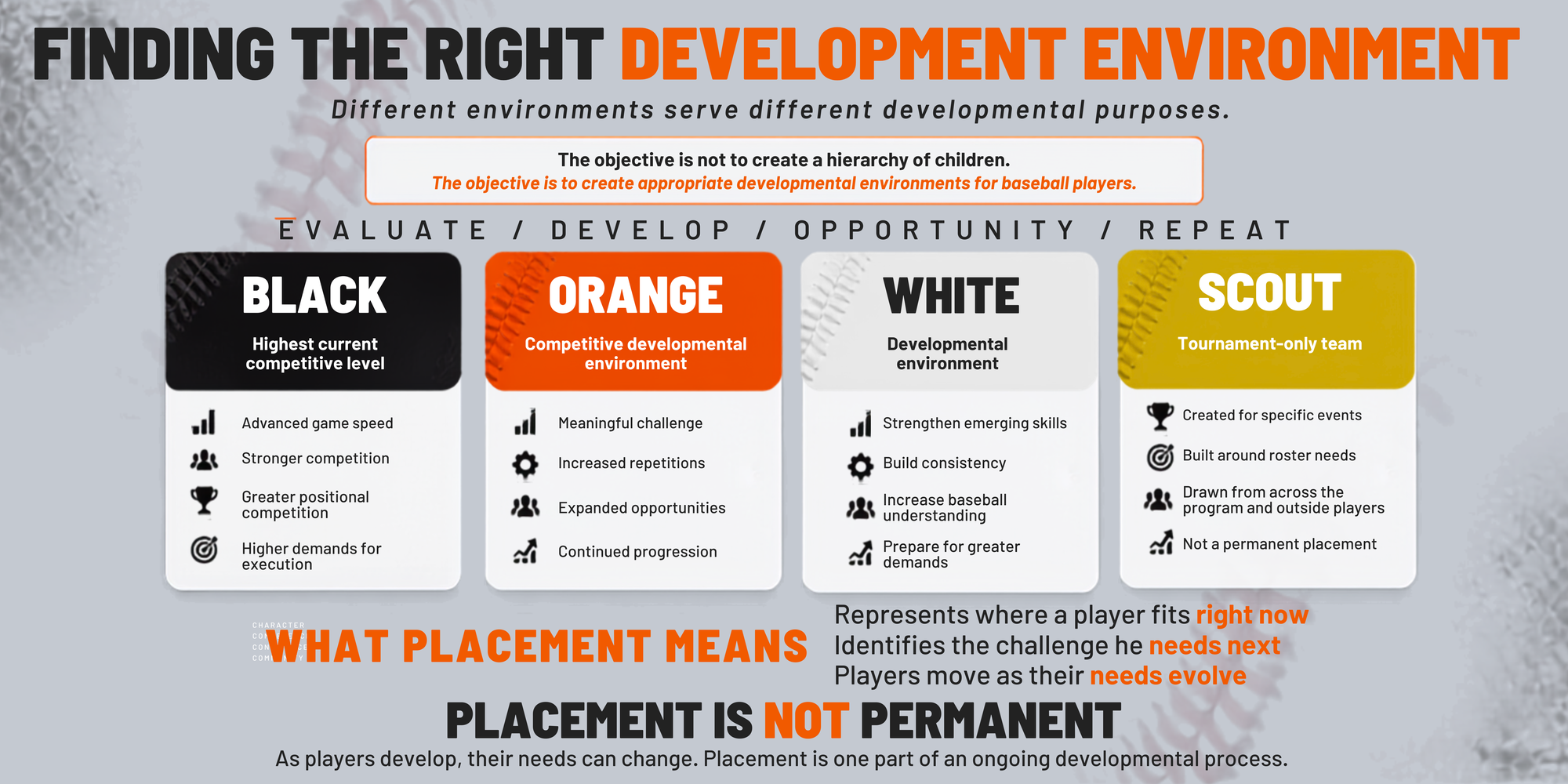
Within age groups where we field multiple teams, our Black roster generally represents the highest current competitive level, while our Orange roster provides a competitive developmental environment designed to continue challenging players while creating meaningful opportunities for growth.
Our White teams represent a more developmental environment, where players can focus on strengthening emerging skills, building consistency, increasing baseball understanding and gaining the repetitions necessary to prepare for greater competitive demands.
We may also form Scout teams for specific tournaments or events. Scout teams are tournament-only rosters assembled around a particular competitive opportunity, roster need or event. Because these teams may draw from different areas of the program, participation on a Scout roster should not be viewed as a permanent placement or separate developmental level.
There are meaningful differences between these environments. We believe being transparent about those differences is healthier than pretending they do not exist.
At the same time, none of these designations should be interpreted as a declaration of a player's value, ceiling or long-term potential.
They represent where we believe the player fits right now, what type of challenge he needs next, and the environment we believe gives him the best opportunity to continue moving forward.
As players develop, those needs can change.
That is why placement within our program is never intended to be a permanent label. It is one part of an ongoing developmental process.
HOW PLAYERS ARE EVALUATED
There is no single statistic, tryout, practice, game or coach that determines a player's placement.
Our staff evaluates players over time and across multiple environments.
Among the factors we consider are:
- Current baseball skill and technical proficiency
- Quality and consistency of game performance
- Baseball IQ and situational awareness
- Bat-to-ball ability and quality of at-bats
- Swing decisions and offensive approach
- Defensive reliability
- Arm strength and throwing ability
- Pitching or catching aptitude, when applicable
- Speed, athleticism and physical readiness
- Positional versatility
- Ability to execute at increasing game speeds
- Competitiveness
- Coachability
- Practice habits and preparation
- Response to adversity
- Ability to apply instruction
- Roster construction and positional needs
- The role and opportunities available to the player on a particular team
Some of these things are easily measured.
Others require experienced coaches to observe players over time.
Both matter.
STATISTICS ARE INFORMATION — NOT THE ENTIRE EVALUATION
Baseball statistics can be valuable, but youth baseball statistics require context.
Batting average alone does not tell us the quality of a player's at-bats.
ERA alone does not tell us how well a young pitcher commanded the strike zone.
A fielding percentage does not tell us what plays a defender can reach.
And statistics accumulated against one level of competition cannot always be directly compared with statistics accumulated against another.
Our staff looks beyond traditional box-score numbers.
We evaluate things such as quality at-bats, hard contact, swing decisions, strike-zone awareness, defensive decision-making, competitiveness, movement quality, command, execution and the ability to translate instruction into games.
The purpose of evaluation is not simply to determine what happened.
It is to understand why it happened and what should come next.
ROSTER CONSTRUCTION MATTERS
Player evaluation and team construction are related, but they are not identical.
We are not simply creating a numerical ranking of players and dividing the list in half.
Baseball teams require positional balance.
A roster may need catchers, pitchers, middle infielders, corner players, outfielders or players capable of filling multiple roles.
Playing opportunity also matters.
A player may sometimes benefit more from receiving meaningful innings, at-bats and positional responsibility on one roster than having a significantly smaller role on another.
Our responsibility is therefore to consider both:
How good is the player right now?
and
Where can we create the most productive developmental experience for that player?
Those answers are not always identical.

PLACEMENT IS NOT A PERMANENT LABEL
One of the most important principles of our program is that evaluations remain open.
Players change.
Bodies change.
Skills change.
Confidence changes.
Work habits change.
Sometimes those changes happen gradually. Sometimes they occur very quickly.
A player who begins a season on one roster may eventually demonstrate that he needs a different challenge.
Likewise, a player may occasionally benefit from competing at another level to increase repetitions, learn a new position or address a specific developmental need.
When appropriate, our coaches may move players between environments, use players across rosters where league rules permit, or reevaluate placement from one season to the next.
Being placed on a particular team at 9, 10 or 11 years old should never become a player's identity.
Youth baseball development is far too dynamic for that.
DIFFERENT ENVIRONMENTS — NOT DIFFERENT STANDARDS
Our expectations do not change based upon the uniform a player wears.
Every Tigers player is expected to:
Compete.
Be coachable.
Prepare properly.
Respect teammates and coaches.
Respond to adversity.
Play the game the right way.
Work to improve.
The training environment, coaching expectations and developmental philosophy remain consistent throughout Rawlings Tigers North Jersey.
What may change is the competitive level, game speed, player role and developmental challenge.
That distinction is intentional.
WHAT TEAM PLACEMENT DOES — AND DOES NOT — MEAN
A placement decision means:
This is where our staff believes the player currently fits within the program based upon the totality of our evaluation and the construction of our teams.
It does not mean:
- We have determined a player's long-term ceiling.
- One roster contains players who matter more than another.
- A player cannot improve beyond his current placement.
- A decision made today will automatically remain the same next season.
- One game, statistic or tryout permanently defined the player.
There are countless examples throughout baseball of players developing earlier, later or simply differently from their peers.
Our job is not to predict an eight-year-old's future.
Our job is to help build it.

OUR RESPONSIBILITY TO THE PLAYER
Sometimes the easiest decision would be to place a player where the family wants him to be.
That is not always the most responsible developmental decision.
Our coaches are expected to make placement decisions based upon what they believe will best serve the player and the program—not based upon outside pressure, comparison with teammates or the desire to avoid a difficult conversation.
We understand that players and parents are competitive.
We expect them to care.
Disappointment is sometimes a natural part of competitive sports.
But we also believe learning to respond to challenge, earn opportunities and continue working when something does not go exactly as hoped is an important part of athletic development.
The question we hope every player eventually learns to ask is not:
“Why am I not on that team?”
It is:
“What do I need to improve to become the player I want to be?”
That is a question our coaching staff can help answer.
WHAT PARENTS SHOULD EXPECT FROM US
Families should expect our coaches to evaluate players thoughtfully, communicate honestly and make decisions with developmental intent.
They should also expect that not every decision will be based on a single statistic, a single performance or an individual family's perception of where a player belongs.
Multiple coaches observe our players.
We discuss development.
We evaluate performance.
We consider positional needs.
We consider roles.
And we continually reevaluate.
No single coach, game or statistic defines a Tigers player.
That is deliberate.
THE LONG VIEW
Youth baseball creates enormous pressure to constantly determine who is "ahead."
We are more interested in where a player is going.
At the younger ages especially, our objective is to build complete baseball players who understand the game, develop strong fundamentals, compete confidently, respond to coaching and gradually become capable of succeeding in increasingly demanding environments.
Some players will move faster.
Some will take longer.
Most will experience periods of both.
That is development.
Our responsibility is to recognize where a player is today, understand what he needs next and provide an environment that helps him move forward.
Evaluate. Identify. Teach. Challenge. Compete. Reevaluate.
Then begin again.

TALKING WITH US ABOUT YOUR PLAYER
We welcome conversations about a player's development. The most productive conversations focus on that player's strengths, developmental priorities and next steps rather than comparisons with other players.
When speaking with our staff, we encourage families to ask:
What is my player doing well?
What does he need to improve next?
What should he be working on?
What would progress look like?