
2027 Program → Jan–Jul
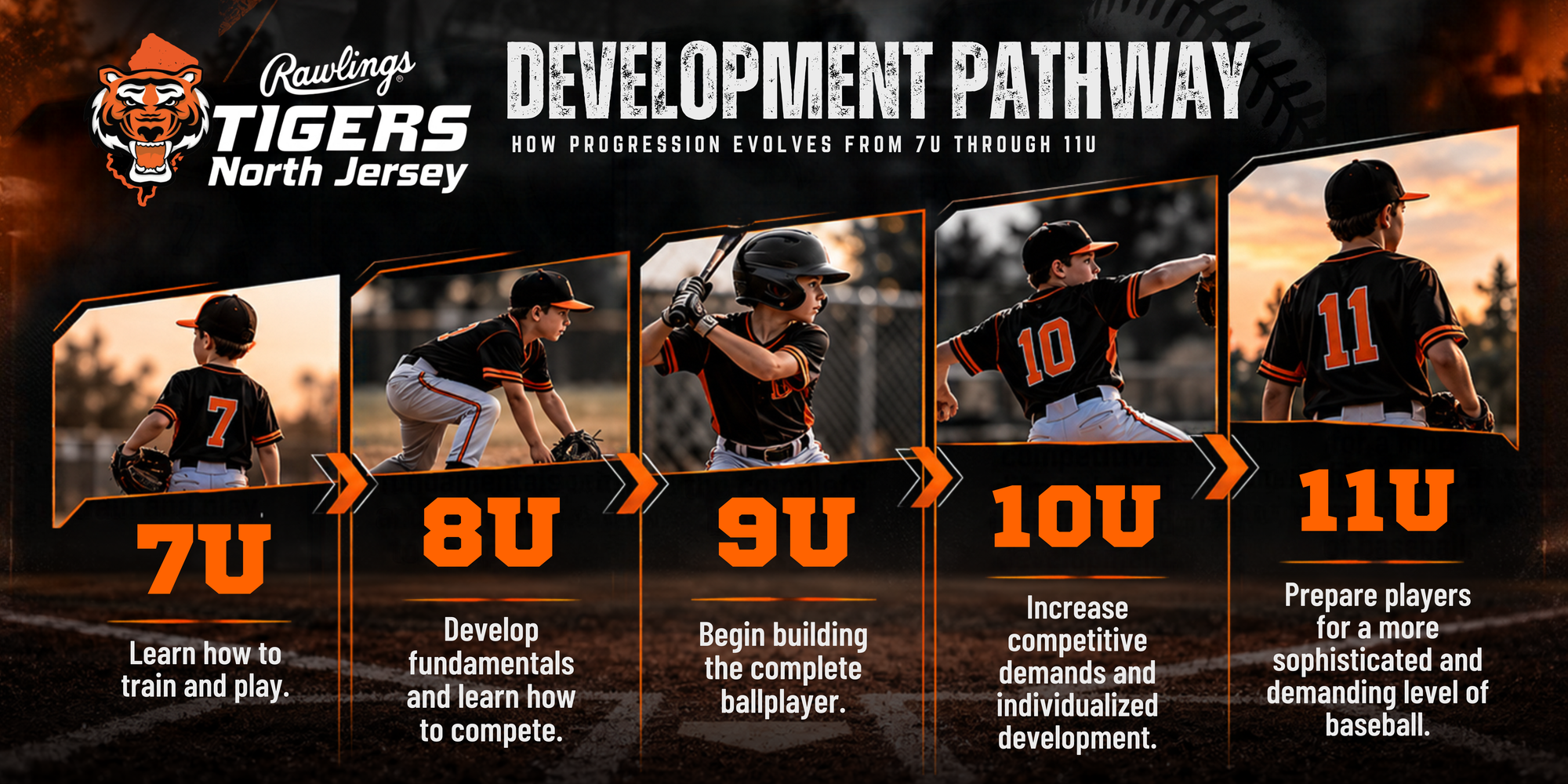
The 2027 Rawlings Tigers North Jersey program is one continuous player-development experience running from January through July. Rather than treating winter, spring, and summer as three disconnected seasons, each phase is designed to build upon the one before it. Players develop during the Winter Arc, apply those skills through spring competition, and enter the summer prepared to compete in increasingly challenging environments. As players advance from 7U through 11U, the training and competitive expectations evolve with them.
2027 Program Phases
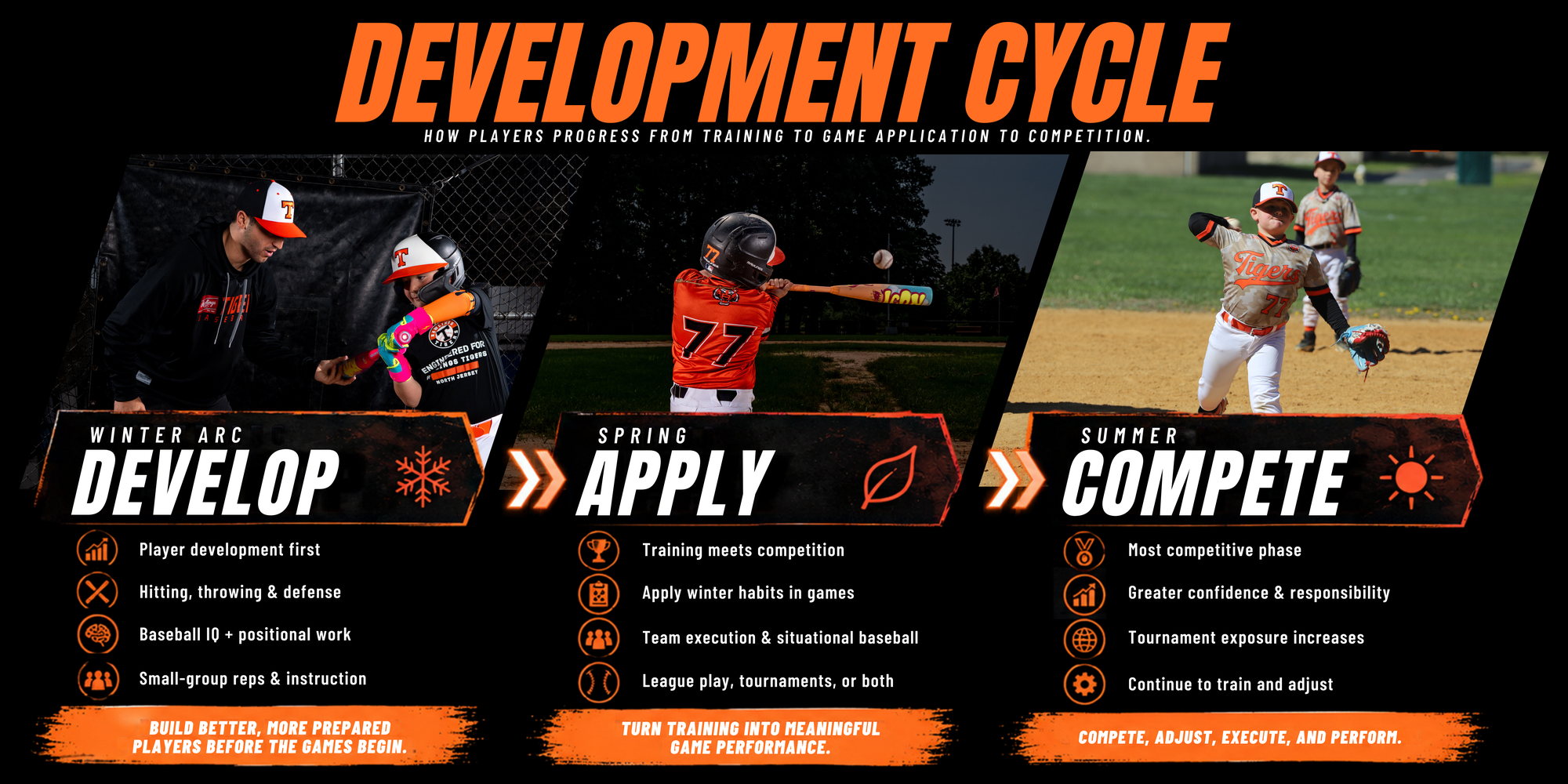
Winter Arc
Develop
The Winter Arc is the foundation of the Rawlings Tigers North Jersey development model.
From January through mid-March, the emphasis is on player development rather than competition. Training is designed to give players the repetitions, instruction, and individual attention needed to improve before the spring season begins.
Players will work through age-appropriate hitting development, throwing progressions, defensive fundamentals, positional training, baseball IQ, movement, and specialized pitching and catching work. Team-based sessions are complemented by smaller-group training to create more repetitions and lower player-to-coach ratios.
The goal of the Winter Arc is simple: build better, more prepared baseball players before the games begin.
Spring
Apply
Spring is where development begins to meet competition.
Players take the skills, habits, and concepts developed throughout the winter and begin applying them in live game environments. Training continues throughout the season, but practices become increasingly connected to game situations, team execution, defensive responsibilities, situational baseball, and individual areas of need.
Competitive schedules are structured according to each team’s age and developmental level, utilizing league play, tournament competition, or a combination of both.
Spring is not the end of development. It is the next step in it.
The objective is to help players learn how to transfer what they have trained into meaningful game performance.
Summer
Compete
Summer represents the most competitive phase of the program.
By this point, players have spent months developing their skills, learning team concepts, and applying those skills in games. Summer provides the opportunity to compete with greater consistency, confidence, and responsibility.
Tournament exposure and competitive demands increase as appropriate for each age group and team level, while development remains part of the process. Players continue to train, receive instruction, and address individual needs throughout the summer rather than simply transitioning into a games-only environment.
The goal is not just to play more baseball.
It is to teach players how to compete, adjust, execute, and perform within increasingly challenging environments.
7U
Learn How to Train and Play
At 7U, the priority is creating a strong foundation and teaching players what it means to learn, practice, and compete within a team environment. Training emphasizes throwing and receiving, basic hitting mechanics, movement, defensive fundamentals, baserunning, communication, and an introduction to the situations and responsibilities that make up the game.
Players are encouraged to experience multiple positions and develop overall athleticism rather than being defined by a single role too early.
Competition is important, but the schedule is built to support development—not replace it. Games provide opportunities to apply what is being taught, learn how baseball works in real time, and become comfortable competing.
The objective at 7U is not to create finished baseball players. It is to build confidence, curiosity, fundamental skills, and the habits that allow meaningful development to begin.
At 8U, players begin turning basic skills into more repeatable baseball actions. The emphasis remains on fundamentals, but training becomes more intentional around hitting approach, defensive footwork, throwing mechanics, receiving, baserunning, game awareness, and positional responsibilities.
Players should still experience multiple positions while beginning to understand where their current strengths may best translate on the field.
Competition becomes a more meaningful part of development. Players learn how to prepare for games, handle success and failure, compete through difficult at-bats or innings, and make decisions under pressure.
Where roster depth supports multiple teams, different competitive environments may be created to provide players with the level of challenge that best supports their development.
The goal at 8U is to develop sound fundamentals while beginning to teach players how to compete with confidence, awareness, and purpose.
8U
Develop Fundamentals and Learn How to Compete
9U
Begin Building the Complete Ballplayer
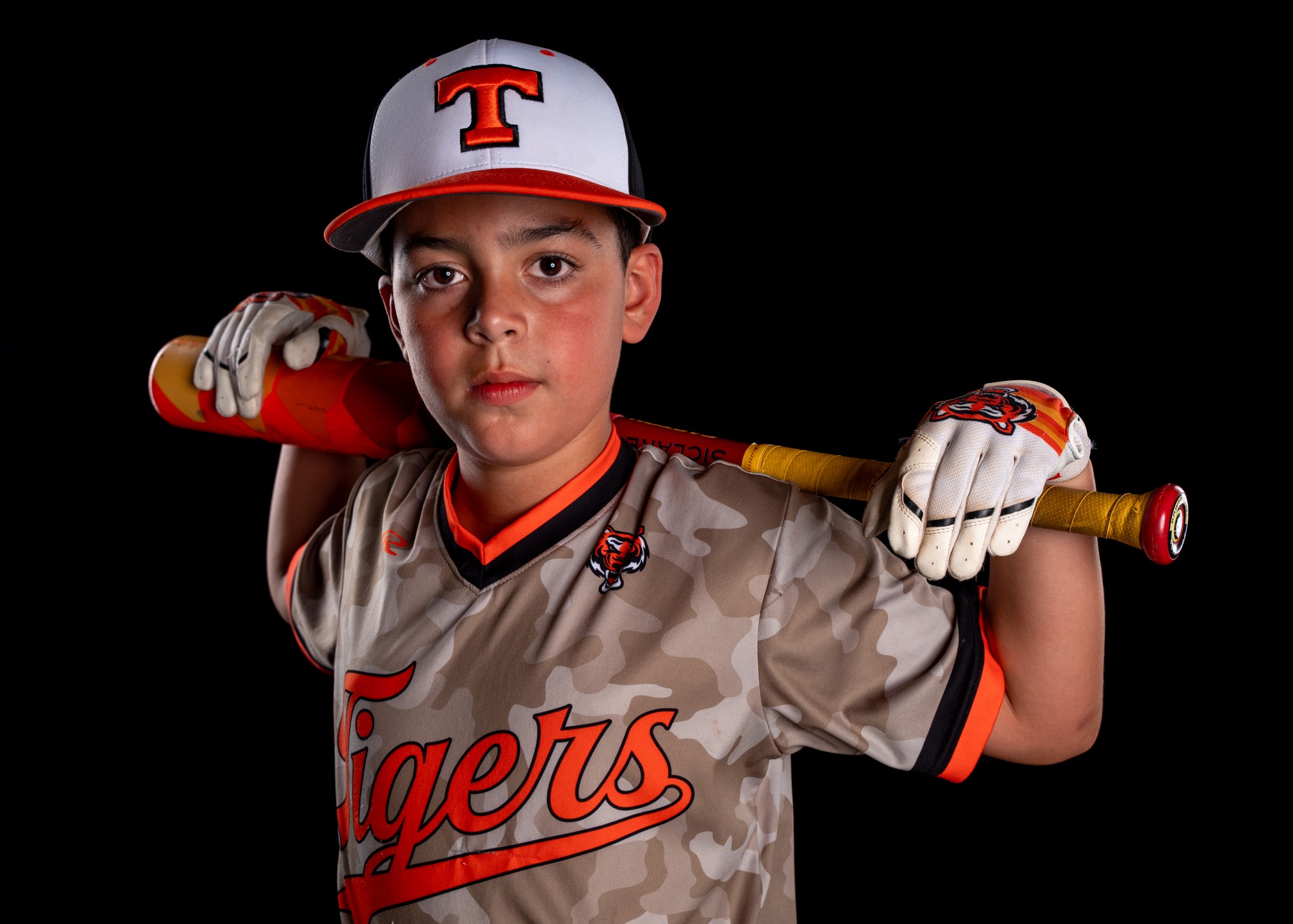
At 9U, the developmental focus expands beyond individual skills toward building a more complete understanding of the game. Players continue to develop hitting, throwing, fielding, pitching, and catching skills while being asked to better understand situations, team defense, communication, baserunning decisions, and their responsibilities away from the baseball.
Training becomes increasingly position-specific without prematurely limiting players to one role. Pitchers and catchers begin receiving more structured development, while offensive instruction moves beyond simply making contact toward approach, swing decisions, and quality at-bats.
Competition also increases. Depending on roster level, teams may combine league play with purposeful tournament opportunities.
At 9U, development and competition begin to work together more closely. The goal is to produce players who are not simply more skilled, but who understand the game, adapt within it, and contribute in multiple ways.
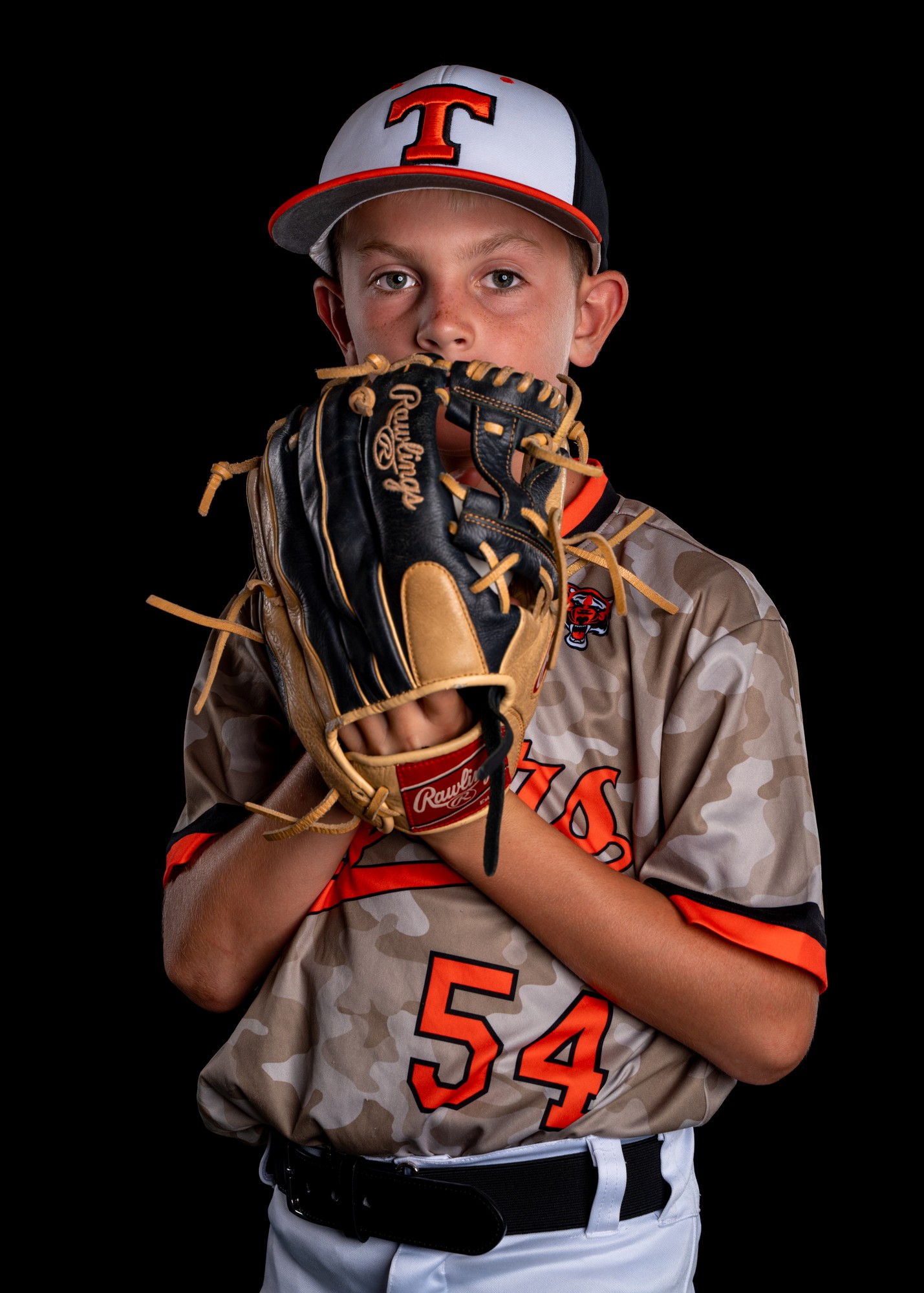
At 10U, players begin taking greater ownership of their development. The fundamentals remain important, but training becomes increasingly individualized as coaches identify specific strengths, deficiencies, positional needs, and areas where each player can make meaningful progress.
Hitting instruction becomes more approach-driven. Pitching and catching development becomes more structured. Defensive training places greater emphasis on footwork, decision-making, positional responsibilities, communication, and executing at game speed.
Competition also becomes more demanding. Players are expected to prepare with greater consistency, understand situations independently, handle defined roles, and respond productively to success, failure, and increased pressure.
Team environments may differ based on current competitive level, with some rosters carrying a stronger tournament component and others utilizing league play with selected tournaments.
The objective at 10U is to challenge players appropriately while creating increasingly individualized pathways for continued growth.
10U
Increase Competitive Demands and Individualized Development
11U
Prepare for a More Sophisticated and Demanding Game
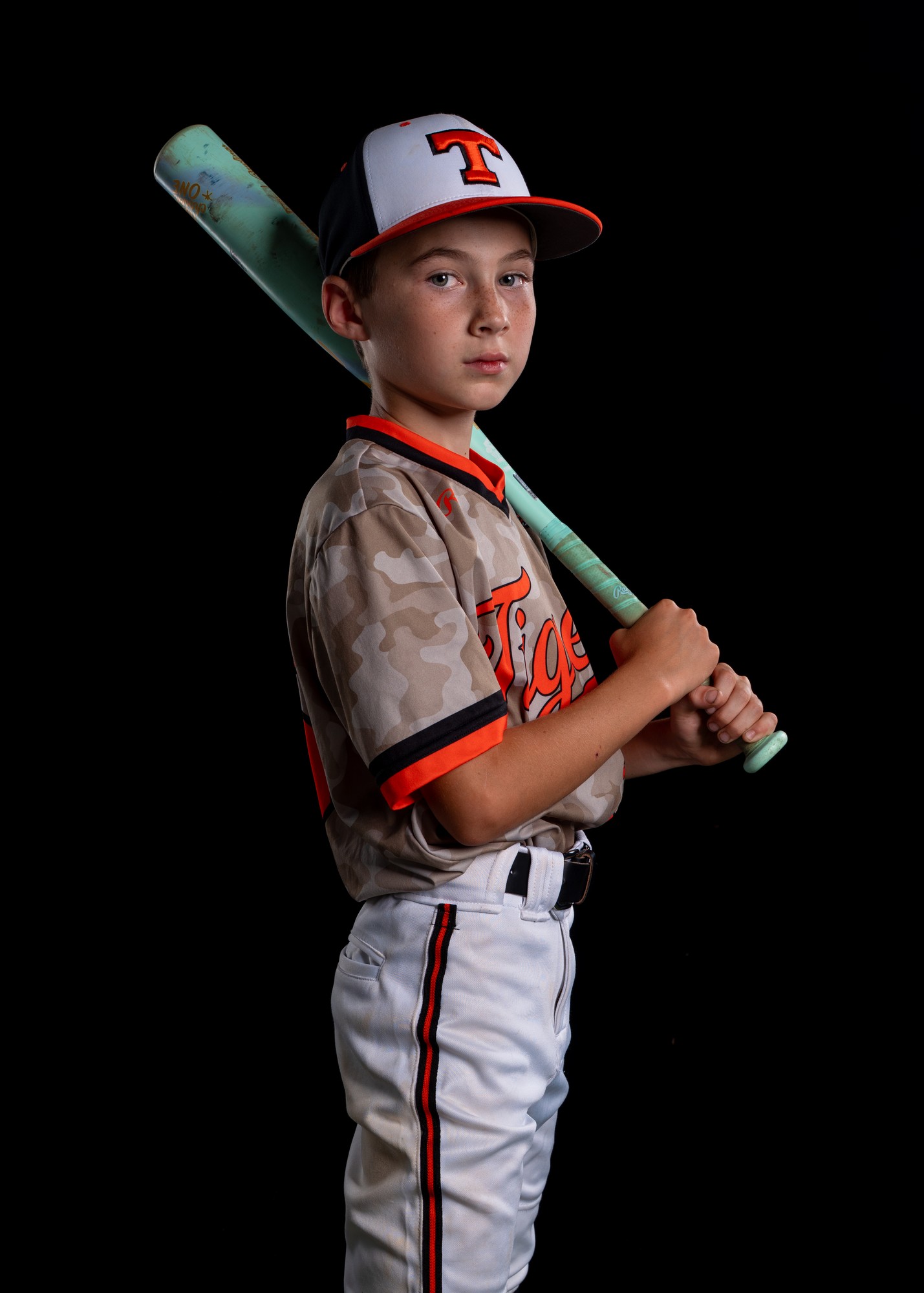
At 11U, players enter a stage where the game becomes faster, more strategic, and increasingly demanding. Development continues, but players are expected to apply their skills with greater independence, consistency, and understanding.
Training places increased emphasis on advanced hitting approach, positional execution, pitching and catching development, defensive responsibilities, situational baseball, baserunning, communication, and overall baseball IQ. Players begin to develop clearer positional identities while versatility remains highly valued.
Competitive expectations also increase. Depending on roster level, schedules may become more tournament-driven, while other teams may utilize league play as the foundation with selected tournament exposure.
Players are expected to compete with greater maturity, understand their role within a team, make adjustments, and take increasing responsibility for their preparation.
The goal at 11U is to prepare players for the more sophisticated, faster, and increasingly competitive levels of baseball that lie ahead.
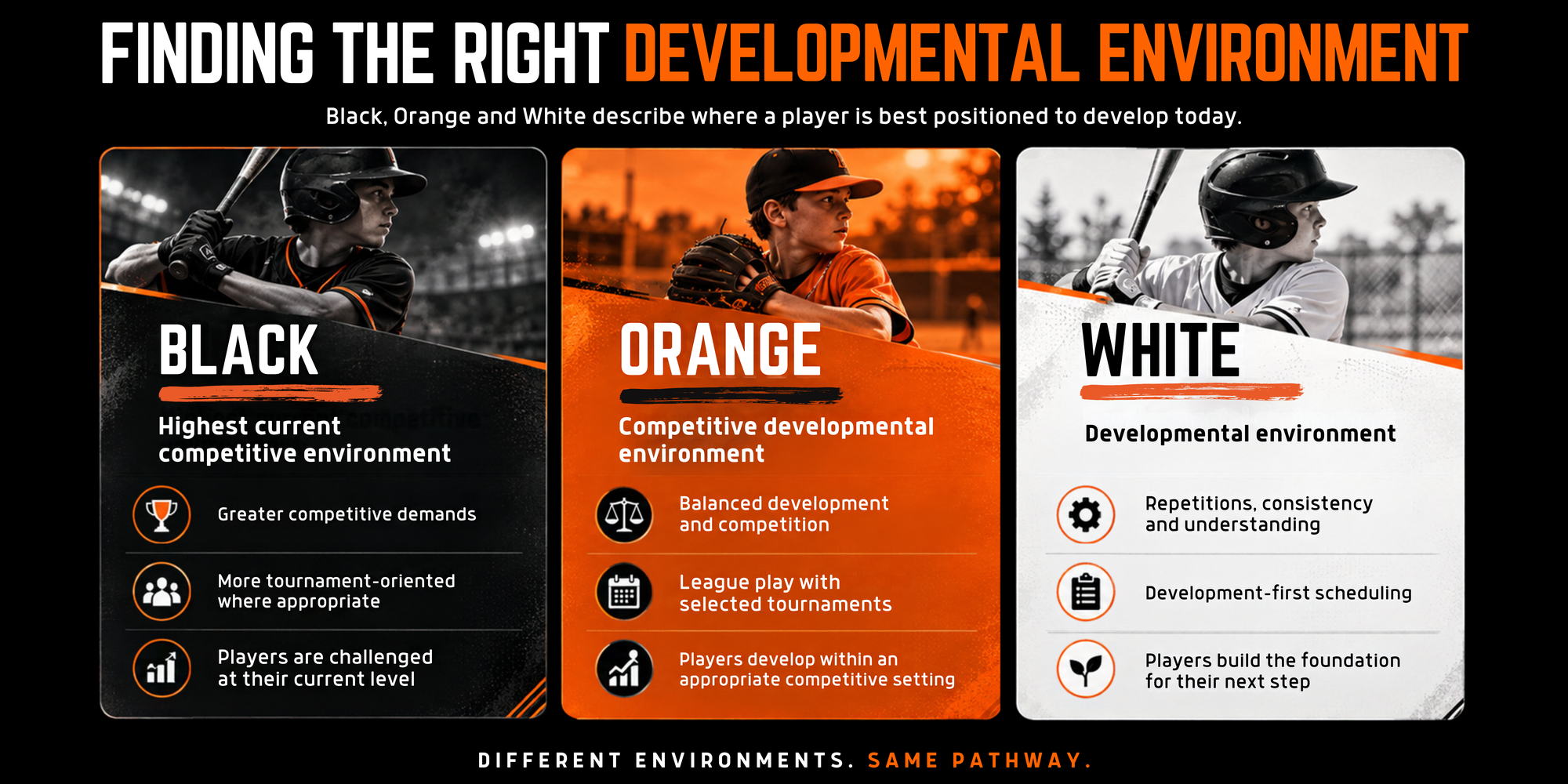
Understanding Levels
Black represents your highest current competitive environment at that age.
Orange represents a competitive developmental environment for players who benefit from a different pace, schedule, role, or developmental setting.
White, where necessary, is primarily developmental and emphasizes repetitions, consistency, game understanding, and preparation for the next level.
Black, Orange, and potentially White are developmental/competitive environments—not guaranteed teams at every age.
Team levels are created where the number and developmental profile of players support multiple appropriate environments. Not every age group will necessarily have every level.
Questions About the 2027 Program?
Choosing the right developmental environment matters. If you have questions about age placement, team levels, scheduling, or whether Rawlings Tigers North Jersey is the appropriate fit for your player, contact rawlingstigersnjinfo@gmail.com.